THE BOSTON MARATHON: 1980 AND 2015, by Mike McGuire

1980

Nineteen-eighty, a time in running when scratching a line on the road would draw a hundred people just to see why the line was there. Then the race would begin. In the mid-70’s, a local event might be $8.00 and include a t-shirt, many of which adorn t-shirt quilts today. Empire Runner water stops often were card tables with cups and a jug of water or two of water, sometimes self-serve. Qualifying for Boston was 2:50 for men under 40, 3:00 for 40 and over and for all women.

In 1980, there were 5,417 entrants (’95 – 9,416, ’14 – 35,755). For this year, the event was capped at 30,000 including 6,000 non-qualified runners. Nineteen-Eighty was perfect for Spring Break but not for running a long way down the road. Since the run traditionally started at noon, with the boom of a cannon in Hopkinson, the sun was already high in the cloudless sky and held no promise of a cooperating temperature. One aid station was a single National Guard soldier, a couple of tables and a ‘water buffalo’ truck with its three inch spigot for filling cups. Offers of water and orange slices may have been festive for the spectators to offer but were life savers to the runners.

May15McGuire4

About ten miles into the race, I bonked. Passing too many aid stations, due to crowding and being too confident from the start, did me in, and I still had a way to go. Most of the journey was just a slog without any key memories other than seeing the Pru in the distance (with it seeming to stay in the distance) and then a couple of turns to the finish. My wife collected me at the finish and escorted (dragged) me to the hotel room of Ken and Shirley Howe where I spent many minutes hugging the toilet bowl feeling the effects of dehydration and exhaustion. Welcome to the finish line! Rosie Ruiz had finished almost an hour before me and was not even winded!

In 1980 I was 35. Thirty-five years later I am running the Boston Marathon for the second time. Same course but a whole different world and event. Qualifying times exist in five year groups from age 18 to ‘over 80’. Qualifying times run from 3:05 to 5:25 for the fastest male division to the oldest female division. There is a ‘rolling’ registration period in which faster qualifying times can ultimately bump slower times. A significant number of non-qualified registrations can be awarded to runners who do fund raising for specific charities. (In the New York Marathon, the charitable donation is $2,620!)

The BAA (Boston Athletic Associate) is in nearly constant contact with entrants with everything from training tips to travel plans and security requirements. (The bombing in 2013 certainly changed event planning!) Along with everyone else, I have received an event passport with maps, time tables and do’s and don’t’s. Also a 22 page official program booklet and an official merchandise catalog. Big events must be very expensive to produce because sponsorship logos adorn every page.

Online comments about this year’s event have been interesting to follow. Boston, along with New York and Chicago, seem to be the ‘big three’ of American marathons with lots of people wanting to collect all three. With run-walking becoming more and more popular, entry fields have swelled. “Getting in” has become a huge challenge. Lotteries, fund-raising, qualifying times and awareness of opening of registration have to be part of one’s master plan.

Is Boston still the premier marathon event with its history and qualifying standards? Or is it merely a marathon that is run in the Boston area? Opinions abound. The 1970 standard was 4:00 hours, men only. 1971, 3:30, men only and a faster qualifying time to keep the run at 1000 entrants – “A good size to keep the course from becoming too congested.” – per a race organizer. 1972, first time women could be official entrants, but everyone qualified with a 3:30 time. 1980, most stringent qualifying time but additional age groups were added for men and women. 1990 through 2012, 3:10 qualifying time but 18 age groups with increasing times. 2013 to present, 3:05 with 22 age groups.

It will still be an exciting event from the expo to visiting friends to trying new restaurants to getting to the starting line and, with dignity, to the finish. Once the run begins, I won’t know age groups from ox carts or qualifiers from non-qualifiers. We’ll run to do our best. With my now-established pattern of attendance, I need to plan for 2050, Boston Marathon #154. I’ll be 105 years old, but the qualifying time should be slower than it is this year.

2015

I arrived in Boston about a week before Patriot’s Day. Those days are a story for another day.
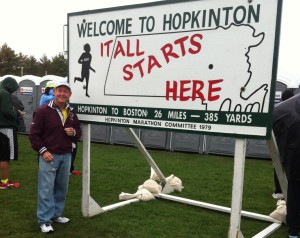
May15McGuire9

On the day of the big event, we were up at 5:15 for a drive from Lee, NH to Hopkinton. The weather forecasts were increasingly grim. Rain, heavy at times, strong winds pretty much all day from Hopkinton to Boston. During the drive, we had heavy weather, lots of rain falling and lots of water being thrown up by the cars and trucks on the road.

The arrival in Hopkinton was easy with volunteers and police officers ready and able to give directions. I was dropped off about two hours before my wave was to move to the start line. (My wife, Sandi and good friend, Bill Bryon, then drove to a train station for their ride to Boston. We would take the train back to New Hampshire later in the day.) I got in line for a shuttle into town. With no bags to check, I was ushered to the front of the line and immediately got on a school bus for the 10 minute ride to the Athletes’ Village.

My outfit for the day, from the outside in, was a Goodwill purchase ‘Portsmouth LaCrosse’ team pull-over and a pair of jeans ($12), long sleeve pull-over, t-shirt, long sleeve pull-over, tights, shorts, hat, gloves, shoes and wool socks. My plan was to shed as the day proceeded. Except for the gloves, I kept my attire for the entire run. Well, actually not the Goodwill outfit. That was deposited in one of the many collection bags. Maybe I can find it again next year!

The Athletes’ Village was the enclosed area of the high school sports fields. Again, there was easy entry, passing smiling security guards and on to a big open field. A light and scattered rain was falling. One side of the gym was lined with runners sitting against the wall; others were walking around, but most were under three large open tents huddled against the wind and rain.

May15McGuire5

Organization of the Village was superb – many potties rimming the edge of the field, jumbo-tron screen with race information, loud and clear PA system with an announcer who kept us informed without over-using the mic. Food and drink galore – coffee, Gatorade, water, bagels, bananas, Clif Bars, Shot Blocks, and gels in never-ending quantities. The area was fairly litter-free, but it will always bother me that some people simply leave things behind rather than walk a few paces to one of the many obvious trash cans.

Easy conversation with fellow runners, especially under the tent where crowding encouraged chatting, always initially about the current weather and what might come. I talked with runners from Canada, Cincinnati, Ventura, New York and Finland. Some were first timers, others repeat offenders. There are fifteen or twenty ‘streakers’ – those who have run 25 or more consecutive Boston Marathons!

I lined up for a pre-race potty stop, perhaps 20 people in line, thinking I had plenty of time before the village exit. I measured my progress against two ladies who had started in the line next to mine. They arrived at their potty door two people ahead of me. Someone else’s line always moves more quickly! A rule of nature. I deposited my outer clothing for its trip back to Goodwill and followed my wave of 7000 down the hill to the start.

All along the .7 mile walk we were greeted by volunteers collecting discardable clothing. The local ‘clothes banks’ did very well by the Boston Marathon. Police in various uniforms were ever present. Neighbors on their porches waved and cheered us on. All this and we had not even run a step!

Once onto the main street (I guess it was the main street because with the crowd, I could not see above the shoulders of those around me!), we were ushered to our starting group by numbers held on long sticks. Everyone was calm and cheerful with no pushing or squirming forward to get an advantage. Gees, it’s a marathon, there’s no need get an extra foot or two! A light rain was falling.

May15McGuire010

My group was still a block or so from the actual start and we moved forward as those ahead of us were sent on their way. We managed a walking start as our starting gun sounded. At this point, about 14,000 runners were already on the road. Since the road slopes down and is fairly straight, all we could see were bobbing shuffling heads. And that was the view for many miles to come.

Many Hopkinton residents sent us on our way with hearty cheers and the knowledge that their day was just about over and they could return to the daily life of a small New England town. Probably within another half hour, the last runner would be on his way and the clean-up and tear-down could begin.

The course is really pretty easy and in the early Spring not yet very colorful. But the crowds and history of the event make up for any deficiencies. The weather may have reduced the number of spectators a bit but is still pretty exciting to be cheered on and on and on. For a bit I felt like a well-known local. Many people shouted encouragement to “Mike”. A tall man passed me a little later with his name, Mike, plastered on the front of his shirt. My rooting section quickly evaporated.

With my GPS watch coaching my pace, I settled into race mode and was very consistent for many miles. I walked through most aid stations and pleased with how my layering was keeping me comfortable. Oh, the litter of clothing – caps, gloves, shirts, pants! Hopefully no one discarded items too soon.

My training for the marathon was lacking in long runs. One 16 miler, several 12 to 14 and a lot of 7 to 10’s. Alternating hamstring and Achilles problems put me behind the typical schedule. My plan (hope) was to run a conservative race and finish in no more than four hours. The plan worked well for 21 miles and then my pace began to slow as I looked forward more and more to the next aid station where I could take a walking break. Toward the end I took out my camera to take some pics but really more to do some walking. But I crossed the finished line with what looked like a running step and only 2 minutes off my 4 hours.

May15McGuire8

The finish line was another example of fabulous organization with dozens of volunteers directing runners to food, drink, wheel chairs and meeting places. We were wrapped in hooded ‘heat retention cape’s, given wonderful finishers’ medals, treated to food and drink, and congratulated for our effort. I was content to know I had warm clothes and friends close at hand.

May15McGuire6

Sandi and Bill and my nephew, Cole, who goes to school in Boston, texted me as to where to go – a short walk to a lunch counter diner with a view of the finish line. After changing into clean dry clothes, I settled in to recount my exploits.

Later we walked a short distance to a commuter train station for the beginning of our trip back to New Hampshire. Next, a wait in an Amtrack station allowed me to fill up donut holes before the hour ride back to our car and the final leg of our trip home. Actually, we stopped at a terrific pizzeria for a couple of slices and pints. And then we went home.

May15McGuire7

Two days later our trip wound down as we were dropped off at Logan Airport. It was fun to see all the marathon shirts and jackets in the terminal. All runners greeted each other with congratulations and comments about the weather and the course. Everyone was in great spirits and convinced they would return next year.

Maybe a new set of ‘streakers’ has been formed.

THE HOKA CLIFTON: THE FINAL REPORT OR AN EXCUSE TO GET A NEW SHOE?, By Brad Zanetti

May15ZanettiHeadshotI bought my first Hoka product in October 2014, the Clifton. It soon became a favorite shoe and a dichotomy: cushy and responsive.

I could continue to bore you with facts and figures, stack heights and drops, no sew speedframes and early meta rocker technologies. If you have been purchasing running shoes for at least a year you have probably heard enough taglines and gobbledygook about this or that companies foam: speedfoam, freshfoam, lunarfoam, boost, blah, blah, blah.

After you have listened to the ads, read the company blurb and found yourself cross-eyed as your shoe fitter extols the virtues of the current shoes they are showing you, take a deep breath, lace em up and run out of the store and really concentrate how those shoes feel. Also don’t be afraid to take a couple of days and some short runs at home to make sure your initial choice was correct. The specialty shoe stores will accept a return.

May15Zanetti4

That all being said, let’s get back to the Hoka. After six months and around 350 miles, this shoe has remained an all-time favorite for me. They aged pretty well and don’t really look any worse for the wear (see picture). The uppers have remained in excellent condition will little obvious wear. The insole that was provided has had some issues, sometimes climbing up the heel which could cause a hotspot or blister if you don’t stop and adjust. What I didn’t realize is that two insoles are provided to adjust fit even further. I have opted to use the second insole with great result. I noted the second insole when I purchased my second pair of Cliftons (red).

You could go back and read the previous review (100mi) and update (220mi), but simply stated, this shoe has been a game changer for my training. It was great out of the box and maintained its feel for over 200 miles. In the last 120 miles or so, it began to lose its resilience but was still adequate for long hilly runs in Annadel, though not quite as responsive as when new and a little less capable on those long rocky downhills.

Would I buy another pair? Yep already have, and my first runs in them have been excellent. Besides the flashy new red color and the insole choices, these are just as I remember my very first run in the original Cliftons — they make me want to lace them up and get out there. They feel great. Think about them, try them on and give them a shot. You might be amazed.

“The Hoka Challenger ATV”

My lastest choice from the Hoka line is the Challenger ATV, a lightweight trail shoe based on the Clifton last. It is now available in better running stores locally ( it was only available locally at REI until March 15).

May15Zanetti2

Putting on the ATV in the store, it felt much like the Clifton in every way with a slightly stiffer feeling sole. I took them out the very next day for an Annadel 10-plus miler and the shoes were great. My feet and joints were painless after. A complete 100 mile review will be in future issues. Hope we get some rain so I can review the lug pattern.

Challenger ATV Tech:

Stack heights:

Heel: 29mm

Forefoot: 24mm

Drop: 5mm

Weight: 8.5oz

No Sew Speedframe/MetaRocker/Stability Pods/4mm Lugs.

The Long and Short of It

May15Peterson2A couple of months ago I read a good book recommended to me by my good friend and fellow runner Dr. Alec “Doc” Isabeau. The book is Younger Next Year by Chris Crowley and Henry S. Lodge, M.D. Although this is not a review per se’, I will say that I highly recommend this book. It inspired me to make a few simple changes to my diet and exercise routine.

  • I stopped buying and therefore eating the delicious chocolate-chip cookies from my local grocery store’s bakery department. It had become a habit to eat one or two and sometimes three of these high-calorie babies every night.
  • I added a third gym workout to my routine. I had traditionally taken Friday’s off. Now I typically run four times per week and do strength-training three times per week.
  • I began doing my very best to go at least 45 minutes in every run or workout. If I can’t make it that long or if I occasionally miss a workout – no big deal, but I no longer plan to take a day off unless I am injured or tapering.

Since I made these three simple changes I have lost somewhere between seven and ten pounds. I used to feel like I had reached my “fighting weight” if I got down to around 156 lbs. Now I am flirting with going under 150 lbs. for the first time in about thirty years. I am running better now than I have in a long time and I feel great.

You don’t have to kill yourself to see positive results. Just make a few changes and give it a little time.

DM Peterson

2014 USATF-PA LDR AWARDS – By John Harmon

Three of our own drew recognition from the Pacific Association of the USATF at its annual Long Distance Running (LDR) banquet – the LDR committee governs the cross country rules, races and awards

Cathy Dubay was named the Outstanding Female Runner of the Year for the 2014 Cross-country Season. In all six races in which she ran, Cathy came first in the Senior Women’s Division – a perfect score which garnered the most individual points possible. As if her racing talents aren’t enough, her enthusiasm and support helped build a roster of 16 Senior Women.

Dale Peterson is a bedrock member of the Empire Runners. He had been an active XC team member until injuries got in the way. He has retaken the trails doing more marathons and long distance races. Along the way, he became a certified USATF official. As such, he has helped at many Pacific Association XC and Road Races joining Bob Shor (whom I’ll get to in a moment). “Dale doesn’t realize it, but he’s good at being an official. Very good.” – Bob’s words. Accordingly, the LDR voted Dale the Volunteer of the Year for the 2014 XC Season.

As for Bob Shor, he is a fixture at any running event. He thoroughly loves officiating. His dedication is unparalleled. And anyone who has experienced Bob’s mastery in person knows “We run on time.” Bob works tirelessly for any event he participates in. For this service, the LDR voted Bob a Lifetime Achievement Award. It doesn’t mean he’s going anywhere soon. He still loves what he does. Except now everyone knows what we have always known – we have a legend in our midst.

Congratulations, Cathy, Dale and Bob!

2005: Empire Runners Win National Snowshoe Championships in Alaska

May 2005: Empire Runners Win National Title at Snowshoe National Championships in Anchorage, Alaska. Download the full pdf: may05ern

May15BackInTheDay

For the third year in a row, the Empire Runners have  been well represented at the United States Snowshoe National Championships. In 2003, Chris Gilbert finished 10th  overall at  the national championships in Salt Lake City, Utah. In 2004, Chris convinced me to join him at the national championships in Squaw Valley, California, where Chris finished 8th  overall, while I ended up 34th .

With the 2005 championships taking place in Anchorage, Alaska, we were able to convince several more club members to join in on the fun this year – Kenny Brown and Brian and Rita Purcell. We all managed to qualify at the Squaw Valley regional race (one of 10 qualifying races) and  made plans to go north.

Unfortunately, Chris Gilbert was not able to make thetrip, but we still managed to take a group of six Empire Runners to Alaska. Brian, Rita, Kenny and myself would race, and our support crew was Kathy Bisordi and Karen Bohn. We all hoped to do a bit of sight seeing as well as compete at the nationals.

Immediately after landing in Alaska, my Mom and I drove around the outskirts of town. We were delighted to get a nice view of Denali (the tallest peak in North America at 20,320 feet) five minutes into our trip! Later that evening we watched the Alaska Aces host the Long Beach Ice Dogs in minor league ice hockey (the only kind there is this year). About eight thousand locals stomped and screamed for their hometown boys, who won in overtime that night.

Saturday morning began with a race, but not running or snowshoeing – we were off to see the start of the Iditarod Sled Dog race! The directors of our snowshoeing race wisely scheduled our event so as to make it possible for us to see the ceremonial start to the Iditarod on Saturday morning. We all decided to set our concerns about racing dogs aside, and went to enjoy the spectacle. It was quite a show! Thousands of spectators lined the streets to watch almost 100 teams begin their 1150 mile journey to Nome. The race was created in 1973 to commemorate the brave trek made by sled dog in 1925 to deliver serum to fight the Diphtheria epidemic that was ravaging Alaska at that time.

Later that day we were finally ready to race ourselves, in Kincaid Park on the outskirts of town. All of uswould toe/shoe the line together, though adults would be racing a 10K and the juniors a 5K. At the sound of the gun, 80 or so individuals who had qualified and traveled great distances took off across the snow. The course took us through a tunnel and off into the woods. It was a great course, with challenging, rolling hills, and a fun mix of road-width and single-track trails – not too different than Annadel really, but with shorter and more numerous hills.

As it has often seemed to end up, Kenny and I traveled a few thousand miles and ended up one after another for most of the race. Kenny was our first runner at 13th  overall (35-39 gold medal) in 47:44 while I was 14th  overall (35-39 silver medal) in 48:04. Brian was close behind in 19th  overall (45-49 silver medal) in 50:46. Rita Purcell was 5th  overall in the Junior Girls race in 45:21. We all had great fun and celebrated later that evening with salmon burgers and milkshakes at a local bar and grill.

Sunday morning bought very sore legs for everyone, but we wouldn’t have time to rest, as today would be the relay component of the snowshoe national championships. In the early stages of our planning, local handicapper Lars picked our team of Kenny Brian, Chris and myself as the team to beat. However, with Chris unable to make the trip the feeling was that we might have to settle for a bit less. I refused to give up however, and put my recruiting skills to work Saturday afternoon and Sunday morning. By race time I had secured the services of our newest Empire Runner, Mike Decker (Michigan) to anchor our team. Mike had finished 5th overall the previous day in the individual race, so we were back in business, though we missed Chris’ presence.

At the sound of the gun, the lead-off runners sprinted into the woods to complete the first 2.5K loop (team total of 10K). The course was well packed and very fast (this may have been what led many runners to miss turns, despite the well-marked course). Kenny led off for the Empire Runners team, followed by Brian, myself, and then Mike. I could write a lengthy play-by-play that would bore most everyone, but instead I’ll ask you to trust me that it was one of the most exciting relay races I’ve seen! Our team ran at our near the lead for the entire race. I handed off to Mike, who led the field into the woods. When we saw him emerge from the trees and head across the meadow a quarter of a mile a way, close on his heels was Mike McManus (of Dipsea fame) who had finished 4th  overall the day before. In a desperate sprint for the finish “our” Mike held off “their” Mike by about a stride for the win. We were National Champions!

Now I’ll admit that snowshoeing is an “emerging” or “growing” sport. And I’d prefer to avoid telling you how many teams were there on Sunday (though there were more teams than there were medals). But a win is a win, and we are the 2005 10K Relay Snowshoe National Champions! Mike graciously declined our offer of the team trophy and said that it belonged with our club. We hope more Empire Runners will join in the fun next year – ask any of us how exciting the snowshoe racing is, and how much fun it is to travel to the championships.

Next year – Bolton Valley, Vermont! Happy (snow-covered) trails, E. J. Bohn

THE NEW BLOG IS HERE !!!!! By Peterson and Murdoch

With great fanfare the Empire Runners Club announces their new blog!   Take a good look and if you have suggestions or want to participate, please let us know!
There are many advantages to the blog format, both creative and practical. On the creative side, the blog really highlights photography and photos of our members, and allows for posting articles and text into  multiple categories. On a practical side, it allows for online workflow allowing club members to participate in the creation, editing, and publishing of Empire news articles.

That being said, there were mixed emotions in the club about no longer creating a printed newsletter. The number of members who contributed to or served as editor for the Empire Runner Newsletter over the last 35 + years has been nothing short of incredible, and all of those people need to be sincerely appreciated for their contribution and dedication. But the reality is that the number of people that requested a printed newsletter dropped to less than five, and the number of people  actually looking at the PDF version were few.  As we know,  newspapers and magazines have declined dramatically in circulation. The current thinking now by most people is that if they want the most current information or news, they check the internet.

FYI, the blog will still be archived on a monthly basis and will be available for people to download. In addition, on the blog itself it allows you to choose a month, so that you can see everything posted, similar to how you would view the newsletter.

RIP Empire Runners Newsletter  – may those that participated over the decades be sincerely acknowledged, as we move into the future enthusiastic as ever about running, racing and the promotion of a healthy life-style.

UNDER CONSTRUCTION

Big-Time Club Changes Coming Soon to You by Paul Berg

That’s the lead story of the Empire Runners newsletter for May 2005 (no typo), so I thought I could just recycle the headline exactly 10 years later. The big news of 2005 was the newsletter going online, emailed in PDF format, with a $5 discount for those members who chose to not receive a printed, mailed copy. For the first time, we were able to join the club online, instead of using a paper form and snail mail, although electronic race registration was still a few years off. Other tidbits include: our bank balance was $5500, a proposal for chip timing at Kenwood, and the first Empire run at Lake Sonoma by yours truly and my middle school daughter. (For the full May 2005 newsletter, click the “Back in the day” tab on the left.)

While that issue of the newsletter provides a perspective of how far we’ve come as a successful, vibrant organization, this month marks another momentous leap forward. In an effort to improve communication and participation, we’re entering the 21st century by launching the new Empire Runners blog. A talented gang of four, Doug Murdoch, Dale Petersen, Chris Mason and Dave Abbott, have been working tirelessly since January on the look and feel of the user experience, and the results are impressive. I encourage you to just wander around the site, clicking on what interests you, and I’m sure you’ll get the hang of it quickly. The logical links, bold photos and interesting content is sure to make us look back in 2025 and say “what took so long?”.

XC Starts in June – Stephen Agar

While our cross-country season can be one of the most enjoyable racing experiences available, combining the camaraderie of team competition with the diversity of trail running, it can also be the most challenging. Such is the depth of our cross county circuit that a performance that would rank in the top five at a local road race may not be enough for a top 30 finish. Nothing can enhance your experience like PREPARATION and the time to start preparing is in June. In my next blog post I will discuss summer training for the cross-country season.

May15Agar2

Located in beautiful Sonoma County, California.

Follow

Get every new post delivered to your Inbox.

Build a website with WordPress.com